BEST PATIOS ALTRINCHAM
Your local paver
Patios can be installed using a variety of products, Indian sand stone, concrete flag stones or York stones being among the most popular.

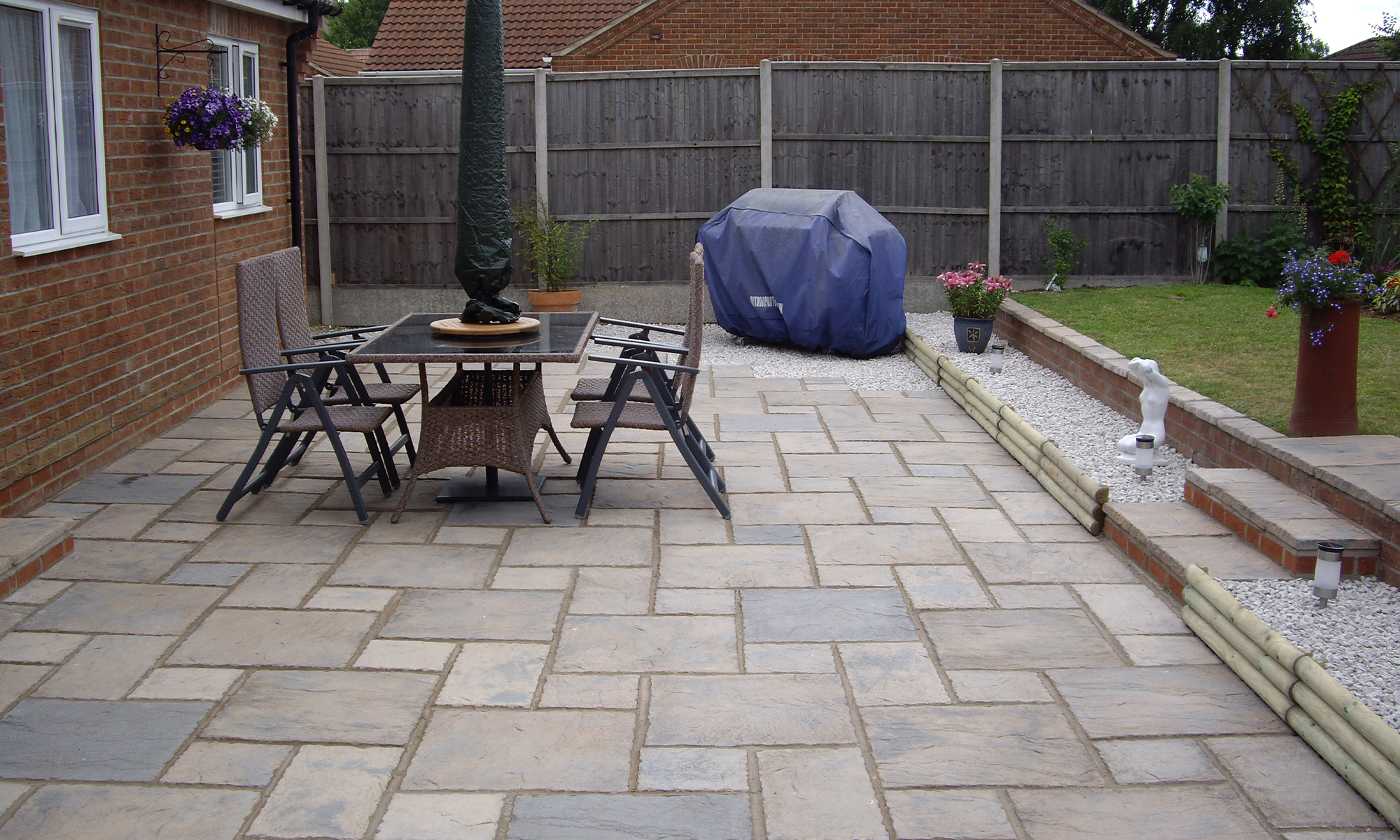
Most Altrincham gardens are unlived in. They’re looked at through the kitchen window, occasionally mowed, and mostly ignored from September through to May. That’s not a criticism, it’s just an honest observation about what happens when a garden doesn’t have a space that invites you to actually be in it.
A well-designed patio changes that completely. It gives you somewhere to put a table and chairs that doesn’t sink into the lawn. It creates a focal point that makes the whole garden feel more finished, more considered, more yours. Done right, it becomes one of the rooms of your home, just one without a ceiling. And in an area like Altrincham, where outdoor living space carries genuine value both for quality of life and resale appeal, it’s one of the most satisfying investments you can make in your property.
This guide will walk you through everything you need to know before you commit: which materials genuinely last, what design decisions make the biggest difference, what a realistic budget looks like in WA14 and WA15, and how to make sure whoever you hire actually delivers the patio you had in mind. Let’s get into it.
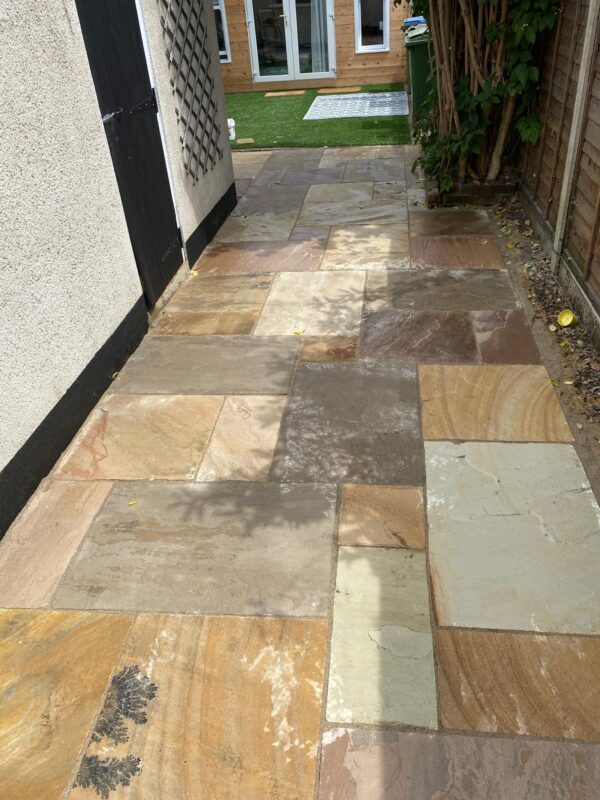
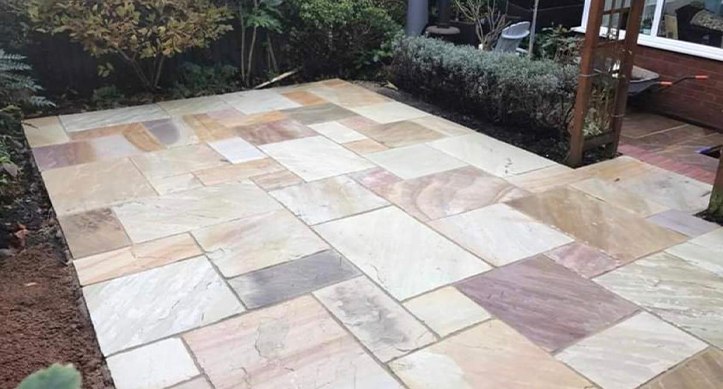
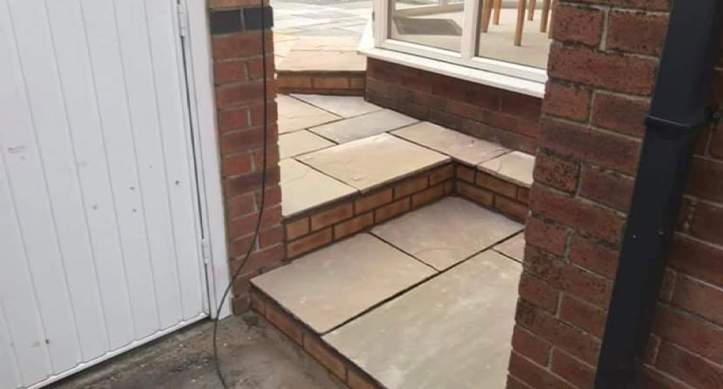
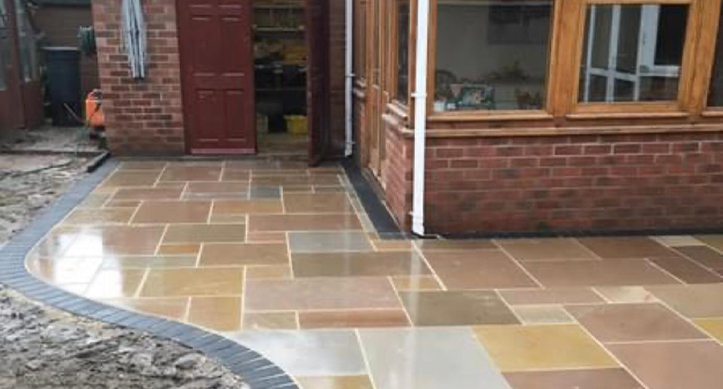
Walk through the residential streets around Altrincham, Hale, or Bowdon and the pattern is consistent: well-maintained house fronts, smart driveways, and, over the back garden gate, a tired patio of mismatched concrete slabs with a plastic garden table balanced on the uneven surface.
It doesn’t have to be that way. The same care and intention that Altrincham homeowners typically put into their interiors is just as applicable to outdoor space, and the returns are comparable. A beautifully designed Indian sandstone or porcelain patio, properly laid on a solid base, with considered lighting and planting around the edges, transforms how you experience your home every single day from the first warm weekend in April through to the last barbecue of October.
The starting point isn’t a sales call. It’s understanding your options well enough to make a genuinely informed decision, which is exactly what this page is here to help with.
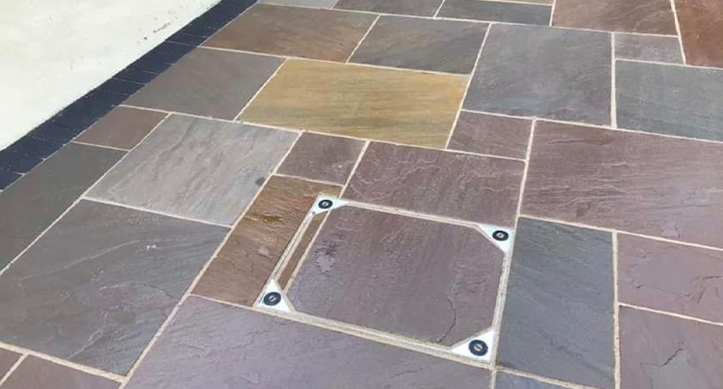
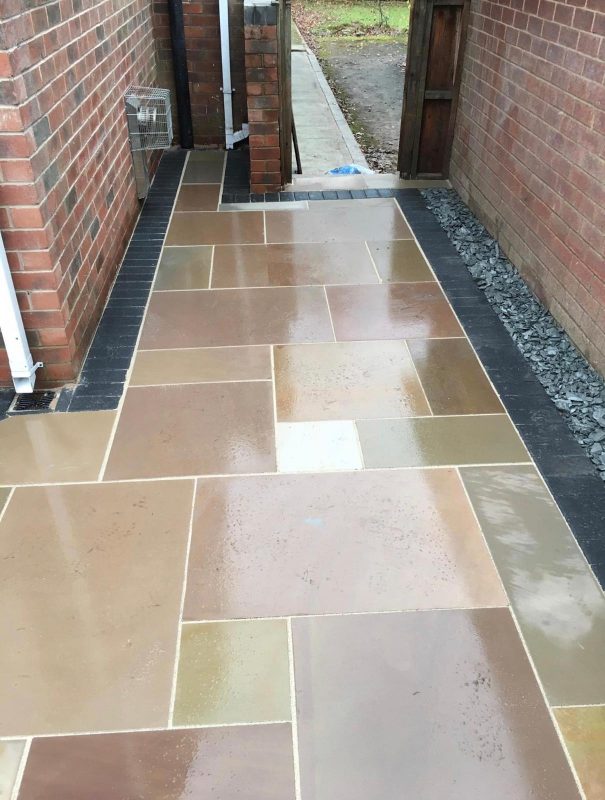
The material you choose determines the character of your patio more than any other single decision. Here’s an honest guide to each main option.
The most popular patio material in Altrincham and across the wider north-west, and for good reason. Indian sandstone is a naturally occurring sedimentary rock quarried primarily in Rajasthan, and its variation in colour and texture, no two slabs are identical, gives it a warmth and authenticity that manufactured materials rarely match.
It comes in several standard colour palettes:
Indian sandstone is moderately priced, easy to cut and lay, and weathers beautifully over time. It does require sealing on installation and periodic re-sealing (every three to five years) to prevent staining and maintain its appearance. In a north-west climate it can develop algae in shaded areas, addressed easily with annual treatment and occasional jet washing.
Best for: Traditional and period properties, warm colour schemes, homeowners who want natural variation and character.
Porcelain paving has surged in popularity across Altrincham over the past five years, and the product has genuinely earned it. Large-format porcelain tiles, typically 600×900mm or 900×600mm, create a seamless, contemporary look that suits modern detached homes, recently renovated properties, and anyone who wants a patio that looks clean and sophisticated with almost no maintenance.
The material is fired at extremely high temperatures, making it:
The trade-off is cost, porcelain paving costs more than Indian sandstone both for materials and installation (larger, heavier slabs take more time and skill to lay accurately). It’s also less forgiving of a poor base, any unevenness in the sub-base telegraphs through a large rigid tile more visibly than it does through smaller natural stone slabs.
Best for: Contemporary and modern homes, low-maintenance priorities, homeowners who want a premium appearance that holds without regular care.
The practical, budget-conscious choice. Concrete flags have come a long way from the municipal grey of twenty years ago, modern concrete paving comes in a wide range of colours, sizes, and riven surface textures that mimic natural stone convincingly from a distance.
They’re consistent in dimension (unlike natural stone, which varies), easy to lay, and significantly cheaper than sandstone or porcelain. The trade-off is longevity and authenticity: concrete flags fade and stain over time in a way that natural stone doesn’t, and they’re visually less distinctive up close.
Best for: Practical projects on a defined budget, utility areas, or when the priority is functional hard standing over design statement.
Proper reclaimed or new-cut York stone is the prestige patio material, and the price reflects it. Quarried in West Yorkshire, York stone has been used for pathways, pavements, and garden features in the north of England for centuries. Its dense, grey-buff surface develops a beautiful patina with age, and genuine reclaimed York stone carries an irreplaceable sense of history and place.
In Altrincham’s older and more characterful properties, particularly the Victorian and Edwardian detached homes in Bowdon and around the conservation areas near the Downs, York stone sets a standard that nothing else quite matches. It’s the natural choice for homeowners who want the patio to look like it was always there.
Best for: Period properties, heritage-adjacent settings, and homeowners for whom quality and authenticity take priority over cost.
Granite is one of the hardest naturally occurring materials used in garden design. Granite sets, small, roughly cubic units typically used for borders, pathways, and feature zones within a larger patio, add texture and visual interest in a way that slabs alone cannot. They’re effectively maintenance-free, handle vehicle loads without difficulty, and never fade.
Cobbles have a more rustic, uneven character suited to cottage gardens and informal settings. Granite sets read as more contemporary and deliberate.
Best for: Feature borders, pathway inserts, edging details, and anywhere that needs maximum durability with strong visual texture.
The material is the foundation, the design is what makes a patio genuinely your own.
Square and rectangular patios are the most common and the easiest to lay, but they’re not always the most interesting. Consider:
The same principles that apply to choosing a block paving colour apply here: reference the house rather than fighting it. A warm buff sandstone against red-brick Trafford properties creates harmony. A cool silver grey porcelain against a rendered white or grey facade reads as deliberate and sophisticated.
The most common mistake: choosing a patio material in isolation without holding a sample against the house brickwork in natural light. What looks right in a showroom or on a screen can read very differently against your specific brick colour and in your specific garden light.
| Property Style | Brick / Facade | Recommended Patio Material |
|---|---|---|
| Victorian / Edwardian | Red / buff brick | Buff sandstone, York stone, autumn blend |
| 1950s–70s semi | Brown / red brick | Sandstone, concrete flags, autumn blend |
| Modern detached | Light render / grey | Porcelain, silver grey sandstone, granite |
| Cottage / rural | Sandstone / cream | Buff sandstone, York stone, cobble borders |
The difference between a competent patio and a genuinely beautiful one is often in the details:
Consistently, yes, with one important caveat. A well-designed, properly installed patio in a material appropriate for the property adds value in two distinct ways.
First, direct value: usable outdoor living space is a genuine desirable in the Altrincham property market. Estate agents in Hale and Bowdon will tell you that gardens with a quality patio show significantly better and create stronger emotional responses from buyers than gardens without one. When buyers can picture themselves in the space, having friends over, sitting outside with a coffee, it moves the sale.
Second, signals value: a high-quality patio signals that the property has been maintained to a standard. It tells a buyer that the owners have invested in the home with care and intention. That implied quality extends to their perception of what they can’t see, the plumbing, the electrics, the roof.
The caveat: a patio that’s poorly designed, uses cheap materials, or shows evidence of settlement, cracking, or inadequate drainage does the opposite. It raises doubts rather than building confidence. This is why getting the installation right matters as much as the decision to build one at all.
In most cases, no. Patios are classified as permitted development under UK planning rules, meaning they can typically be installed without a planning application provided:
For most domestic gardens in Altrincham, Hale, Timperley, and Sale, a standard patio installation is straightforwardly permitted development. If your property is in a conservation area or has any existing planning conditions, it’s worth checking with Trafford Council before work starts. A reputable contractor will flag any potential issues during their site visit.
Patios must be laid with a fall, a slight gradient away from the house, typically around 1:80 to 1:60, to ensure surface water drains away from the building. This isn’t optional; water pooling against a house wall causes damp penetration and long-term structural problems.
On larger patios or where the natural drainage path is restricted, a channel drain across the lower edge connected to a soakaway or drainage run is the correct engineering solution. Your contractor should specify the drainage approach before laying begins, not treat it as an afterthought.
Like driveways, a patio is only as good as what’s beneath it. The standard specification for a domestic patio sub-base:
Any contractor who proposes laying slabs directly onto existing soil, old grass, or a thin screed without proper hardcore preparation is offering you a patio that will be uneven and cracking within two seasons. On the clay-heavy ground common across parts of the Altrincham area, sub-base preparation is particularly important, clay moves seasonally with moisture changes, and a thin or poorly compacted base will telegraph every movement straight through to the surface.
A patio rarely exists in isolation, and doing complementary projects simultaneously is almost always the most cost-effective approach. Common combinations that work well together:
The difference between a properly built patio and one that will be a source of frustration within two years is almost entirely down to contractor quality. Here’s what to look for:
✔ They assess the ground before quoting — Ground conditions, drainage, existing levels, and access all affect the specification and the price. A meaningful quote cannot be produced from a photograph.
✔ They specify sub-base depth and drainage in writing — If the quote just says “lay patio” without specifying hardcore depth, mortar bed, falls, and drainage, that’s a specification you cannot hold them to.
✔ They discuss the fall away from the house — Any contractor who doesn’t mention drainage gradient before laying slabs adjacent to your property is cutting an important corner.
✔ They recommend appropriate jointing — Premium polymer jointing compound is worth specifying. A contractor who insists on standard sand pointing to cut costs is making a decision that will require their reattention within a season.
✔ They have a local portfolio — Ask to see patios they’ve installed in Altrincham, Hale, Timperley, or Sale that are at least two or three years old. Settlement, cracking, or drainage failures typically show up within two winters.
✔ They carry written guarantees and insurance — Ten years workmanship guarantee, full public liability insurance, in writing before work starts.
✅ Measure your garden and identify the approximate area you want paved
✅ Note where you want water to drain away from the patio surface
✅ Look at your house brick and façade before choosing a material colour
✅ Decide whether steps, raised planters, or borders are part of the design
✅ Consider whether adjacent projects (walls, fencing, lawn) should be combined
✅ Hold physical material samples against your house in daylight before committing to a colour
✅ Get at least three written quotes with sub-base depth and drainage specified
✅ Ask each contractor to show you a local patio they’ve installed at least two years ago
How long does a patio installation take? A standard patio of 25–40 m² typically takes two to four days for an experienced team, including excavation, sub-base preparation, laying, and jointing. Larger patios or those with complex designs, steps, or raised walls take longer. Polymer jointing compound requires 24–48 hours to cure before the surface is in full use. Your contractor should give you a realistic project timeline at the quoting stage.
Does a patio need planning permission in Altrincham? Not in most cases. Patios at ground level on residential properties are generally permitted development under UK planning rules, provided they don’t cover more than half the garden and the property isn’t listed or subject to specific planning conditions. If you’re in or near one of Altrincham’s conservation areas, around the town centre, parts of Bowdon, or near the Downs, it’s worth a quick check with Trafford Council’s planning team before work starts. A reputable installer will advise on this during their site visit.
What’s the best patio material for a period property in Altrincham? Indian sandstone in buff or autumn tones, or reclaimed York stone, are the two most sympathetic choices for Victorian and Edwardian properties. Both materials have the warmth, natural variation, and sense of age that looks authentic next to period brickwork. Porcelain, while excellent, tends to read as contemporary, which works brilliantly on modern homes but can feel slightly incongruous against a 1900s-era house front. This isn’t a rigid rule, there are clever contemporary patios on period properties, but warm natural stone is the safe and usually the beautiful choice.
How long will an Indian sandstone patio last? Properly installed Indian sandstone on a sound sub-base will typically last 20–30 years. The stone itself is extremely durable; the factors that shorten patio life are almost always sub-base failure (which causes settlement and cracking) or inadequate jointing (which allows water ingress and frost damage at the joints). Sealing on installation and resealing every three to five years significantly extends the lifespan and maintains appearance.
Does a patio need to be sealed? Indian sandstone and York stone benefit significantly from sealing. An appropriate impregnating sealer fills the pores of the stone, preventing staining from wine, grease, moss, and the general accumulation of organic material. It also makes cleaning far easier. Porcelain does not need sealing, its non-porous surface is inherently stain-resistant. Concrete flags benefit from sealing, though less critically than natural stone.
Will my patio crack? If the sub-base is correctly prepared and compacted, and the slabs are properly bedded, cracking is very unlikely. The most common cause of patio cracking is sub-base movement, often caused by inadequate hardcore depth on clay-heavy ground, poor compaction, or tree root activity. On Altrincham’s clay soils, specifying a slightly deeper sub-base (100mm rather than 75mm of hardcore) is worth the modest additional cost for the added protection against seasonal ground movement.
Can a patio be installed close to the house wall? Yes, and in fact, most patios connect to the house. The critical requirement is that the finished patio surface must be at least 150mm below the damp proof course (DPC) of the house. Your contractor should identify and respect this level during installation. A patio laid too high against a house wall will cause damp penetration into the lower courses of the property over time.
What is the difference between pointed and grouted joints? Pointing refers to filling the joints between paving slabs with a mortar or compound. Standard sand pointing is the traditional approach but has limitations, it washes out over time in heavy rain and allows weeds to establish. Brush-in polymer jointing compound (sometimes called resin jointing sand) is the modern premium alternative: it cures to a firm, flexible set, is largely weed-resistant, and won’t wash out. The cost difference is modest; the performance difference is significant. Always specify polymer jointing for a new patio.
How do I maintain my patio once it’s laid? Maintenance requirements are modest for all patio materials:
Can I have underfloor heating under a patio? Electric underfloor heating mats can be installed beneath external paving, and are increasingly popular for covered outdoor entertaining areas and under porcelain tiles close to the house. It’s a specialist installation that needs to be planned from the outset, retrofitting heating beneath an existing patio is a full relaying job. If you’re interested in this feature, raise it at the quoting stage so the contractor can specify accordingly.
The best time to install a new patio in Altrincham is before summer, but the planning and material selection take time worth investing properly. A patio that you’ll genuinely use and enjoy for the next 20 years deserves more than a rushed decision and the first quote you receive.
Deluxe Driveways designs and installs patios across Altrincham, Hale, Bowdon, Timperley, Sale, and the wider Greater Manchester and Cheshire area. We source quality materials, prepare sub-bases correctly, specify drainage properly, and finish with premium polymer jointing that will still look good in five years’ time. Every project comes with a 10-year workmanship guarantee, full public liability insurance, and a free no-obligation quote.
We can also handle everything else your exterior might need at the same time – block paving or resin driveways at the front, garden walls and raised planters, artificial grass, fencing, and decking — turning a single project into a complete garden transformation.
Call 0800 191 0959 today for your free quote, or fill in the contact form and we’ll be back in touch within one working day. No pressure, no obligation, and a 14-day cooling-off period on everything we quote.

Deluxe Driveways are a property maintenance company with many years of experience in a range of areas. Deluxe Driveways take pride in delivering the quality results which you deserve.
Deluxe Driveways are more than happy to offer FREE, no-obligation quotes. We are here to work closely with you on any projects.
From block paving and resin to patios and deckings, Deluxe Driveways expertise spans across many fields and are on hand to cover you for all of your needs.
Deluxe Driveways's experience in the paving & driveway industry is second to none, we have been around for a while and seen almost everything on the job so you can be confident in hiring us!
Deluxe Driveways cover a wide geographical area including Greater Manchester & Cheshire. Please get in touch to find out if Deluxe Driveways cover your area.
We endeavour to always leave our customers satisfied with our high quality work and this includes causing as little disruption as is possible and leaving your property clean and tidy.
Greater Manchester & Cheshire
30 The Downs Altrincham WA14 2PX