Professional decking
Deluxe Driveways undertake all resin bound driveway work. Get in touch for a no-obligation quote!


Some of the best garden transformations begin with a problem that isn’t immediately obvious. A kitchen door that opens onto a one-metre drop. A long, flat garden that feels like a corridor rather than a destination. A sloped plot that has defeated every attempt to create usable, level outdoor space. A house that looks inward, with no real connection between inside and out.
Decking, designed and built properly, solves all of these, and creates something that genuinely extends the liveable space of a home rather than just adding another surface to the garden. A well-considered deck is an outdoor room. It has the same relationship to your kitchen or living room that a proper extension would, at a fraction of the cost and disruption.
The question isn’t whether decking could work for your Altrincham garden. It almost certainly could. The question is which material, which height, which design, and which contractor will deliver a result that still looks as good in ten years as it did on the day it was finished. This guide answers all of it, honestly, specifically, and with the north-west climate fully in mind.
Before the material comparison and the cost tables, it’s worth being clear about what decking is actually for, because understanding its purpose helps define what the right solution looks like for your specific garden.
It creates level usable space from uneven or sloped ground. Many gardens in Altrincham, particularly the longer, slightly sloping plots common in Hale, Bowdon, and Timperley, have areas that are simply not usable as they are. A deck built over the slope creates a level platform that can carry furniture, people, and life. No amount of landscaping achieves this as efficiently.
It connects indoor and outdoor space. A deck at the same level as the kitchen or living room floor, or just one step down, creates a genuinely seamless indoor-outdoor transition. This is the condition that makes outdoor entertaining feel natural rather than like an expedition to the garden. It’s the difference between a door that opens onto a useful extension of your living space and one that opens onto a drop to a lawn two feet below.
It creates distinct zones in a large garden. A long, undifferentiated garden is harder to use and harder to furnish than one that has defined spaces with different functions. A deck at the house end creates a dining and entertaining zone; the garden beyond can be lawn, planting, or further landscaping. The deck provides the anchor that makes the rest of the garden make sense.
It adds genuine value to the property. A professionally designed and built composite deck, particularly one that connects fluidly to the house, reads to prospective buyers as an additional room. In the Altrincham market, where outdoor entertaining space is consistently cited by estate agents as a purchase motivator, a well-built deck is a straightforward kerb-appeal investment.
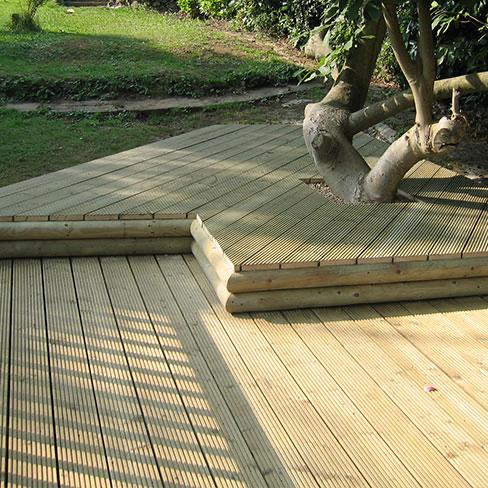
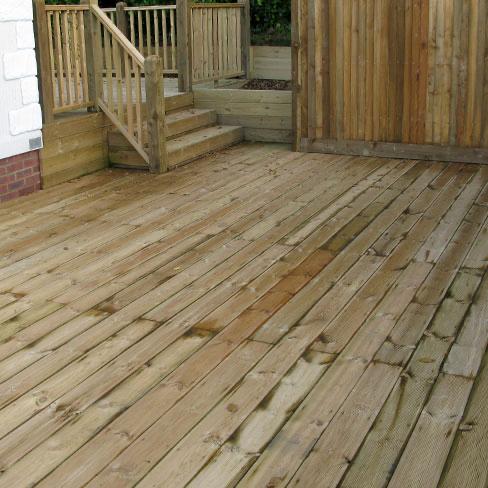
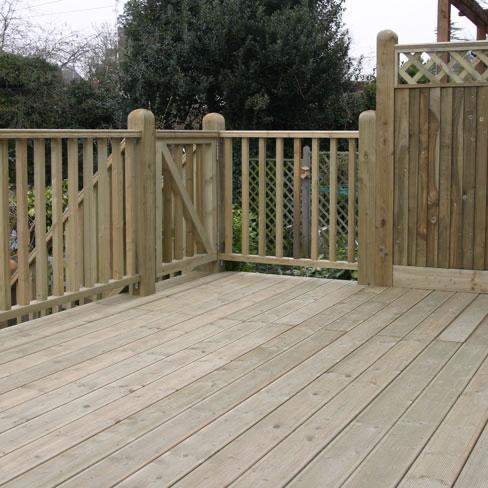
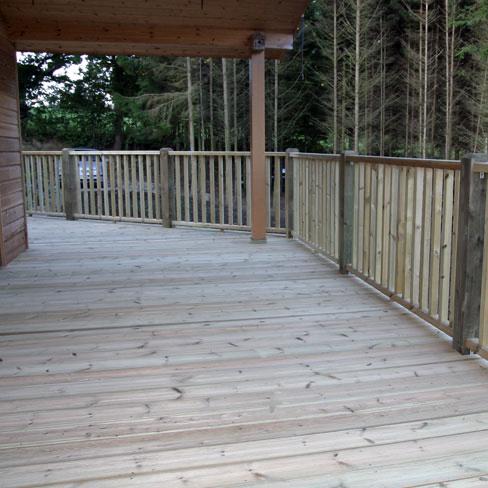
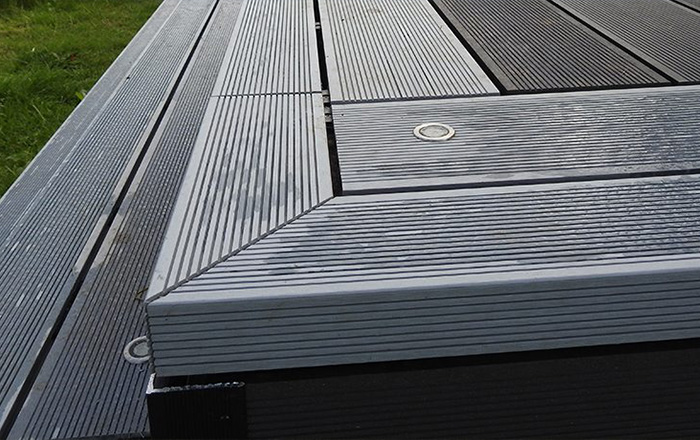
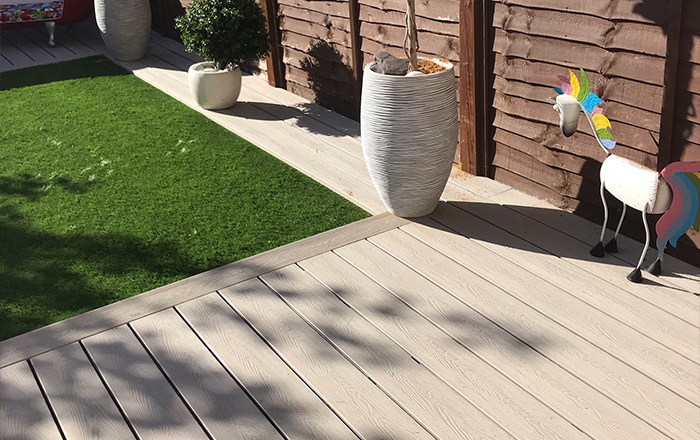
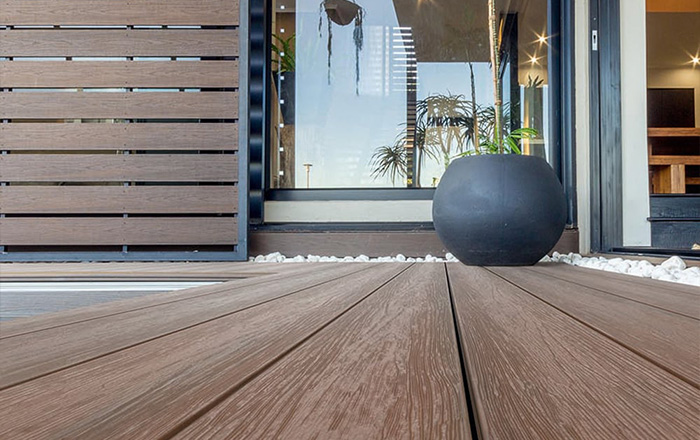
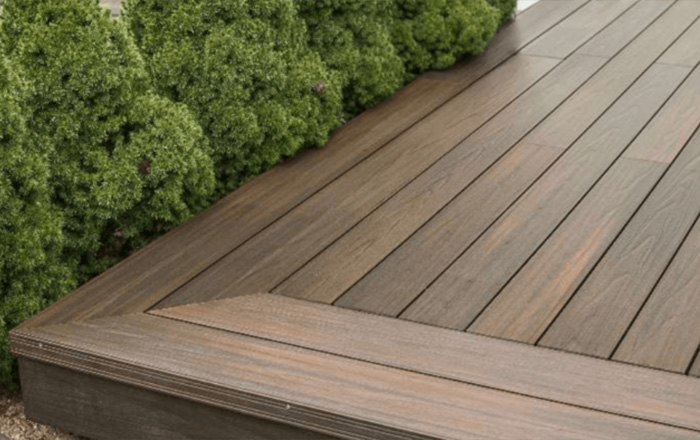
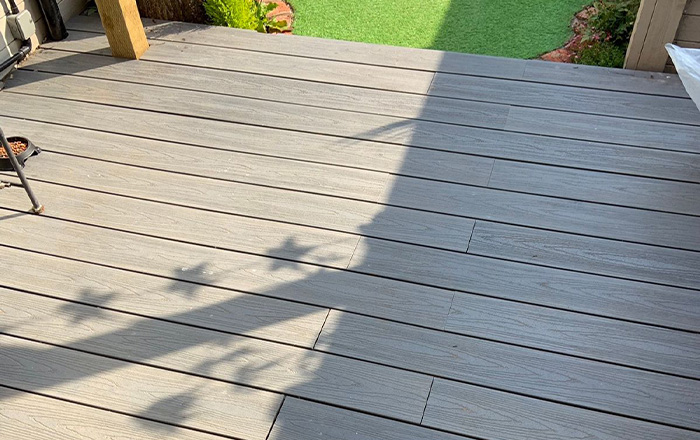
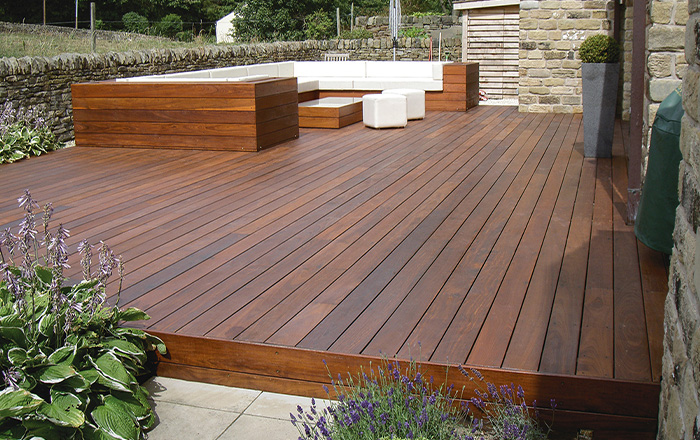
The material choice you make at the outset determines the maintenance commitment, the lifespan, the appearance over time, and the long-run cost of your decking. Getting it right depends on being honest about what you actually want from your outdoor space, not just in the first summer, but in the fifth and the tenth.
The most widely sold decking material in the UK and the most frequently replaced. Pressure-treated softwood, typically pine or spruce, kiln-dried and pressure-impregnated with preservative, is the cheapest decking option at point of purchase.
The honest assessment: softwood decking looks excellent when freshly installed, stained or oiled to the homeowner’s preference. Within two to three years in the north-west climate, without consistent annual maintenance, it begins to grey, split along the grain, and develop green algae in the shaded joints. By year seven or eight, many softwood decks are a significant maintenance burden, or a replacement decision.
Softwood decking has a place: for projects with a defined short-term purpose, for homeowners who genuinely commit to annual oiling, or where budget constraints make it the only viable option. But anyone who asks honestly “will I actually maintain this every year?” should consider the long-run cost comparison with composite before committing.
Lifespan with maintenance: 10–15 years Lifespan without maintenance: 5–8 years
Naturally durable hardwoods, ipe, teak, bangkirai, and western red cedar, offer significantly better longevity than softwood and are genuinely beautiful materials. The density and natural oils of hardwood resist moisture, insect damage, and surface decay far better than softwood without chemical treatment.
Hardwood decking is the premium timber choice for Altrincham homeowners who want natural wood and are prepared to invest in the material. It requires less maintenance than softwood but is not maintenance-free, periodic oiling (every two to three years rather than annually) maintains appearance and protects the surface. Without any treatment it greys attractively to a silver tone, which some homeowners prefer.
The sustainability consideration: some hardwood species have complex supply chain provenance. FSC-certified hardwood is the responsible specification, ask your contractor to confirm certification before ordering.
Lifespan: 20–30 years with periodic maintenance
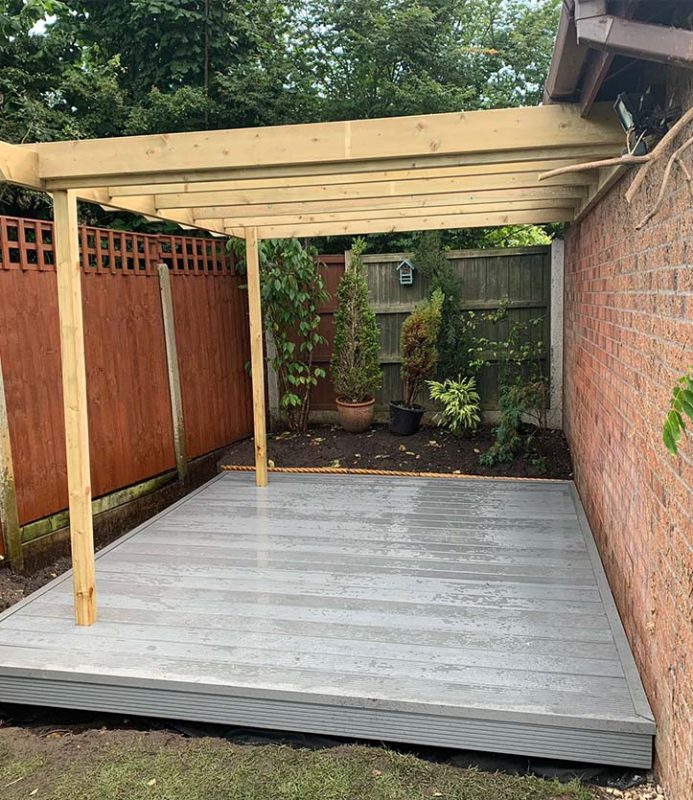
The product that has transformed the decking market over the past decade, and for genuinely good reasons. Composite decking boards are manufactured from a blend of wood fibre and recycled plastic (polyethylene or PVC), encased in a protective outer shell that makes the board resistant to moisture, rot, insect damage, UV fading, and surface staining.
The result is a decking product that:
The upfront premium is real. But over a 25-year horizon, accounting for zero maintenance cost and no replacement, composite almost always represents better overall value than timber for homeowners who plan to remain in their property for more than a decade.
Lifespan: 25–35+ years with minimal maintenance
A less common but practically effective choice for specific applications, particularly covered areas, balconies, and settings where the visual character of composite or timber isn’t the priority. uPVC is completely impervious to moisture and requires virtually no maintenance, but its visual character is more utilitarian than wood-effect composite. Best considered for hidden or utility applications rather than primary entertaining decks.
If composite is your likely direction, the specification decisions within that category are worth understanding, because the quality gap across the composite market is wider than most homeowners realise.
Solid core composite boards are denser, heavier, and harder-wearing, they’re the choice for high-traffic areas and anywhere load-bearing performance matters. They’re also more resistant to denting under point loads (furniture legs, for example).
Hollow core composite boards are lighter, slightly less expensive, and perfectly adequate for most domestic decking applications. The hollow chambers also make them somewhat easier to cut and fix. Quality hollow core boards perform excellently in standard residential use.
Most composite boards are manufactured with grooved edges on both long sides, designed for a hidden clip-fixing system that attaches the board to the frame without face-screwing. This produces a completely clean deck surface with no visible fixings, and is the standard installation method for quality composite.
Ungrooved boards are face-screwed in the traditional way. Less elegant visually, but acceptable for lower-visibility areas.
Quality composite manufacturers offer extensive colour ranges, from warm teak and golden oak tones through grey-browns and charcoal to contemporary grey and silver. The surface finish typically replicates the appearance of brushed or sawn timber grain.
The same principle applies here as to all exterior materials: hold samples against your house in natural light before committing. A warm teak tone that looks beautiful in a showroom can read differently next to your specific brick or render colour. Most quality composite suppliers offer sample packs, always use them.
The deck boards are the visible element, but the frame beneath them is what determines whether the whole structure is solid, level, and long-lasting or increasingly problematic within a few years.
Foundation options:
Frame timber specification:
For timber-framed composite decks, the joists and beams should be:
The most common structural failure mode: a deck frame built with undersized or inadequately treated joists, spaced too widely, on footings that weren’t anchored below the frost line. The boards above look fine while the structure beneath gradually deteriorates, moves, and ultimately compromises the surface. This is what separates a ten-year deck from a twenty-five-year one.
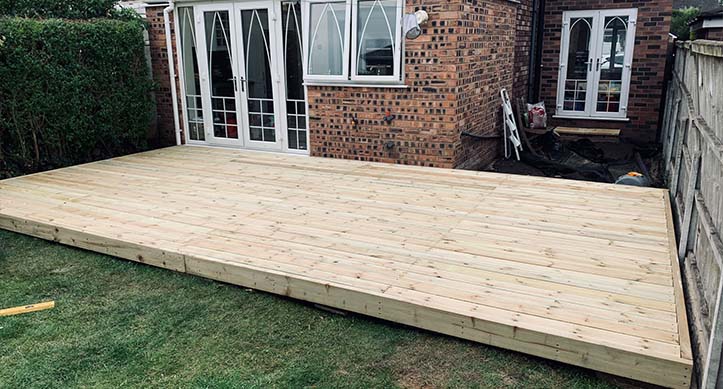
The simplest application and, for many Altrincham gardens, the most practical. A ground-level deck, sitting 50–150mm above the garden surface, creates a defined level area for furniture and outdoor living without the structural complexity of an elevated platform.
Ground-level composite decking is particularly effective as a replacement for a neglected patio: it installs faster, requires no excavation or sub-base work, and produces a warmer, more comfortable underfoot surface than stone.
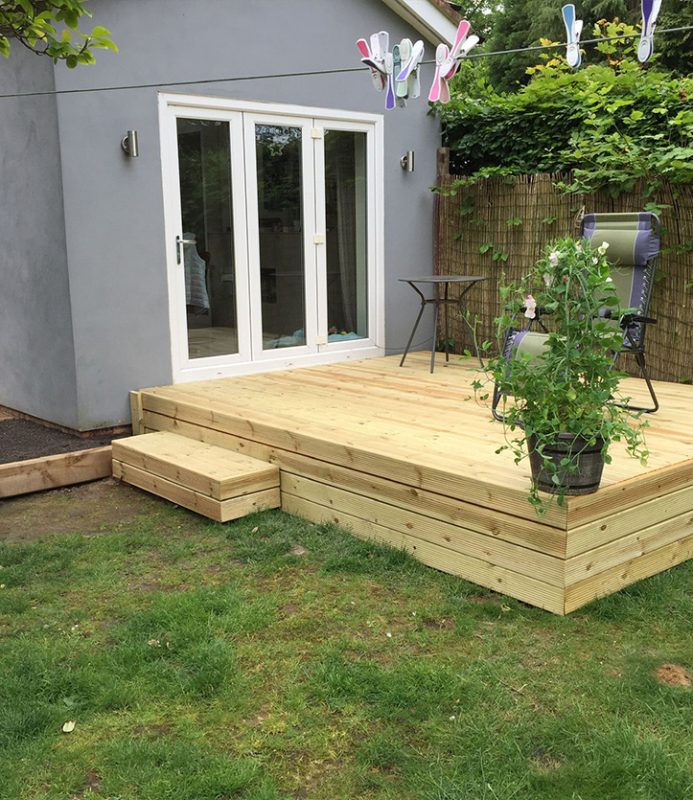
Where the house floor level is above the garden, or where the garden slopes away from the house, an elevated deck creates the seamless indoor-outdoor connection that defines the best outdoor spaces. The frame rises from the garden level to meet the house door threshold, producing a platform that reads as an extension of the interior floor.
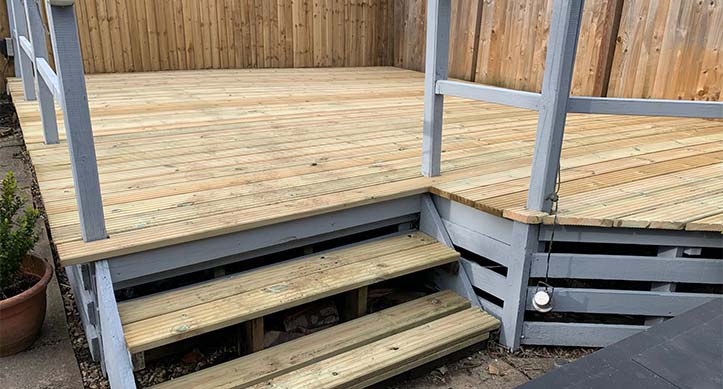
Multi-level decking, where two or three platforms at different heights are connected by steps, is the design solution for gardens with significant changes in level. It creates distinct spaces (upper level adjacent to the house for dining; lower level for seating or play) while making the level change a feature rather than a problem.
For houses with doors or windows on two adjacent faces, kitchen on one side, living room on the other, a wraparound deck connects both openings to the garden on a single continuous platform. This is particularly effective on properties that have been extended or where the kitchen and a rear reception room both face the garden.
The elements that elevate a deck from functional to genuinely designed:
Decking falls under permitted development in most residential situations, but there are important conditions that specifically affect some Altrincham properties:
The conservation area consideration is particularly relevant in Altrincham. Parts of Bowdon, around the Downs, and the historic core of Altrincham town centre have conservation area status. If your property is in or adjacent to one of these areas, a quick pre-application check with Trafford Council’s planning team before work starts is a sensible investment of an hour.
A reputable contractor will identify and raise any planning considerations at the quoting stage rather than leaving you to discover them after work has begun.
Altrincham and the wider Greater Manchester area presents specific challenges for outdoor timber structures that are worth understanding:
Persistent moisture. The north-west’s rainfall pattern, frequent, consistent, and spread across the year rather than concentrated in summer storms, creates a persistently damp environment that accelerates the deterioration of untreated or under-maintained timber. Softwood decking in this climate degrades at the lower end of its stated lifespan without consistent annual maintenance. Composite decking’s resistance to moisture is a particularly meaningful advantage here, not just in drier regions.
Green algae. The combination of moisture and periodic shade across many Altrincham gardens creates conditions where green algae establishes rapidly on timber decking surfaces, making them dangerously slippery within a season. Composite decking with a brushed or textured surface is significantly more resistant to algae colonisation, and the anti-slip properties of the engineered surface texture don’t degrade in the way that smooth timber grain does when wet.
Temperature cycling. Freeze-thaw cycles through Altrincham’s winters cause timber to expand and contract, loosening fixings, opening grain along splits, and working joints in the frame. Well-specified pressure treatment and the use of stainless steel or hot-dipped galvanised fixings (not standard bright steel, which rusts rapidly in wet conditions) are the correct response to this. Composite boards are largely unaffected by freeze-thaw cycling.
Sheltered vs exposed positions. Gardens in the more sheltered, tree-lined roads of Bowdon and Hale behave differently from more exposed gardens in Timperley or Sale. Wind loading on elevated decks with full balustrades in exposed positions needs to be considered in the frame design.
Pressure-treated softwood:
Hardwood:
Composite:
The honest composite maintenance summary: if you treat your composite deck annually, it will look marginally better. If you don’t, it will still look perfectly acceptable with only the occasional wash. This is not true of softwood.
Decking rarely exists in isolation from the rest of the garden, and the best results come from designing it as part of a coherent outdoor scheme.
Natural project combinations:
Combining projects means coordinated design, shared mobilisation costs, a single period of disruption, and a finished result where everything relates to everything else.
Decking installation requires both carpentry skill and structural awareness. The contractors who deliver lasting results are identifiable before any work starts:
✔ They visit and assess before quoting — Ground conditions, slope, house door threshold height, drainage, and access all affect the specification. A quote produced without a site visit is an estimate at best.
✔ They specify the frame explicitly — Joist spacing, timber grade, treatment specification, and foundation type should all be stated in the quote. If none of these appear, the contractor has not yet decided on them — which means they’ll be decided in the field on the day, which is how structural shortcuts happen.
✔ They specify stainless or hot-dipped galvanised fixings — Standard bright steel fixings rust within two to three years in the persistent moisture of a north-west garden. This is a specification detail that good contractors state without being asked.
✔ They raise planning implications — Elevated decks and conservation area properties both have planning implications. A contractor who doesn’t raise these at the site visit hasn’t thought about them.
✔ They have a portfolio of completed decks at least two to three years old — Ask to see them. Time is the test of a deck’s structural performance and material durability.
✔ They carry full public liability insurance — Essential for any elevated structure or work adjacent to the house.
✔ They provide a written workmanship guarantee — Ten years is the benchmark for quality operators.
✅ Measure the approximate area, length × width in metres squared
✅ Note the height of the house floor/door threshold above the garden level
✅ Identify the primary purpose, dining, lounging, play, or multi-zone
✅ Decide on material preference, timber or composite, with honest self-assessment of maintenance commitment
✅ Consider whether integrated features (seating, lighting, balustrades) form part of the brief
✅ Check whether your property is in a conservation area or whether the deck will exceed 300mm height
✅ Think about whether adjacent projects (patio, walls, fencing, lawn) should be combined
✅ Get three written quotes with frame specification explicitly stated
✅ Ask each contractor to name the composite product or timber grade being specified
Do I need planning permission for a deck in Altrincham? Decking is generally permitted development for most residential properties, but with important conditions. Decking that exceeds 300mm above ground level at any point requires planning permission. Decking that, combined with other outbuildings and extensions, covers more than 50% of the garden area is not permitted development. Properties in conservation areas, parts of Bowdon, the Downs area, and near Altrincham town centre, may need consent for decking even within the permitted height. Always verify with Trafford Council before proceeding on elevated decks or conservation area properties. A reputable contractor will flag this at the quoting stage.
Is composite decking really worth the extra cost? For most Altrincham homeowners who plan to remain in their property for more than five years, yes, unambiguously. The upfront premium over softwood is real (typically 2–3× the material cost), but composite requires zero annual maintenance, has a 25+ year lifespan, and performs significantly better in the north-west’s persistent damp conditions. Over a 15-year horizon, the total cost of composite (purchase + negligible maintenance) is routinely lower than softwood (lower purchase + annual oiling + possible replacement in year ten). The honest calculation almost always favours composite for anyone with a long-term view of their property.
How long does a composite deck last? Quality composite products, from established manufacturers using cap-stock technology and UV-stable pigmentation, carry 25-year structural warranties. In practice, well-installed composite decking in domestic conditions typically outlasts that warranty comfortably. The frame beneath the deck (timber joists and posts) has a shorter lifespan than the composite boards above it, which is why frame specification matters as much as board selection. A composite deck on a correctly specified pressure-treated frame will deliver 25–30 years of performance with minimal maintenance.
How long does it take to install a deck? A straightforward ground-level composite deck of 25–35 m² typically takes three to four days for an experienced team, one day for frame and foundation installation, two to three days for boarding, balustrades, and finishing. Elevated decks requiring significant post and beam structure take longer. Multi-level designs, complex balustrade systems, or integrated features add time proportionally. Concrete footings require 24–48 hours of curing time before the frame can be loaded, which affects the programme sequence.
What is the difference between solid core and hollow core composite boards? Solid core composite boards are denser throughout, heavier, and more resistant to denting and point loads, they’re the choice for high-traffic applications. Hollow core boards have chambers running along their length, making them lighter and marginally less expensive. Both perform well in standard domestic applications. For most residential decking projects, hollow core boards from a quality manufacturer are perfectly appropriate. Your contractor should specify which they’re using and explain the choice for your application.
Can composite decking be installed over an existing timber deck? In some cases, yes, but it requires a structural assessment of the existing frame first. Composite boards can only be overlaid onto an existing frame if that frame is structurally sound, correctly spaced for composite, and adequately treated to support another 25 years of service. In practice, most timber frames that have been in service long enough to make replacement boards desirable are also showing structural wear that makes overlay inadvisable. A full strip back and frame inspection is almost always the correct approach before any overlay decision.
Will my deck be slippery when wet? Composite decking with a brushed, textured, or embossed surface has excellent wet-weather slip resistance, significantly better than smooth-grained timber in the same conditions. Smooth timber decking, particularly softwood that has developed algae, is one of the most slip-prone residential surfaces, a genuine safety concern, especially for older users or children. The engineered surface texture of quality composite maintains its grip characteristics even after years of use and weathering. If slip resistance is a specific concern, a north-facing deck, a shaded garden, a household with elderly occupants, composite is the clear recommendation.
What balustrade options are available for elevated decks? The main options are: timber post and rail (traditional, paintable, matches hardwood decks); composite post and rail (maintenance-free, matches composite boards); stainless cable or rod (contemporary, open, preserves views); toughened glass panels (premium, completely open sight lines, requires professional installation); and powder-coated aluminium (contemporary, very durable, available in any RAL colour). The choice affects both cost and character significantly, discuss it explicitly at the design stage rather than leaving it as a default.
Can decking be installed right up to the house wall? Yes, but with important detailing requirements. The deck frame must maintain a minimum 150mm clearance below the damp proof course (DPC) of the house wall. The junction between the deck and the house wall must be properly flashed and sealed to prevent water ingress. A ledger board (a structural beam bolted to the house wall to support the deck frame at the house edge) must be fixed into the structural masonry, not just into surface render. These details are where water damage and damp problems originate on poorly installed decks, and a competent contractor will address them explicitly at the design stage.
What happens if a composite board gets damaged? Unlike timber, composite boards cannot be sanded back or re-stained to address surface damage. A damaged board needs to be replaced. In a hidden clip-fixing system, individual boards can be removed and replaced without disturbing the surrounding boards, a significant practical advantage over face-screwed systems. For this reason, it’s worth requesting that the contractor leaves two or three spare boards (matching the batch) on completion, so any future replacement is an exact colour match to the original installation.
A deck done properly is one of the most transformative investments an Altrincham homeowner can make. It creates space you’ll actually use, every warm evening from April to October, and beyond with the right lighting. It connects your home to your garden in a way that makes both feel bigger and better. And when it’s built in composite from a quality manufacturer on a correctly specified frame, it will still be doing exactly that in twenty-five years.
Deluxe Driveways designs and installs decking across Altrincham, Hale, Bowdon, Timperley, Sale, and the wider Greater Manchester and Cheshire area. We work in pressure-treated softwood, hardwood, composite, and uPVC, and we specify frames correctly, the right timber grade, the right fixing specification, the right foundation for your ground conditions. Every project comes with a 10-year workmanship guarantee and full public liability insurance.
We also handle everything your garden needs alongside the deck, patios and hard landscaping, turfing and artificial grass, garden walls and steps, boundary fencing, and driveways at the front, so if now is the moment to take on the whole garden, we’ll make it work as one cohesive project.
Call 0800 191 0959 today for your free no-obligation quote. We’ll visit, assess your space and house threshold height, give you honest material and structural advice, and provide a written price with a 14-day cooling-off period.

Deluxe Driveways are a property maintenance company with many years of experience in a range of areas. Deluxe Driveways take pride in delivering the quality results which you deserve.
Deluxe Driveways are more than happy to offer FREE, no-obligation quotes. We are here to work closely with you on any projects.
From block paving and resin to patios and deckings, Deluxe Driveways expertise spans across many fields and are on hand to cover you for all of your needs.
Deluxe Driveways's experience in the paving & driveway industry is second to none, we have been around for a while and seen almost everything on the job so you can be confident in hiring us!
Deluxe Driveways cover a wide geographical area including Greater Manchester & Cheshire. Please get in touch to find out if Deluxe Driveways cover your area.
We endeavour to always leave our customers satisfied with our high quality work and this includes causing as little disruption as is possible and leaving your property clean and tidy.
Greater Manchester & Cheshire
30 The Downs Altrincham WA14 2PX