BEST FENCING ALTRINCHAM
Garden fencing & gates
Whatever your budget, we have a quality solution for you.

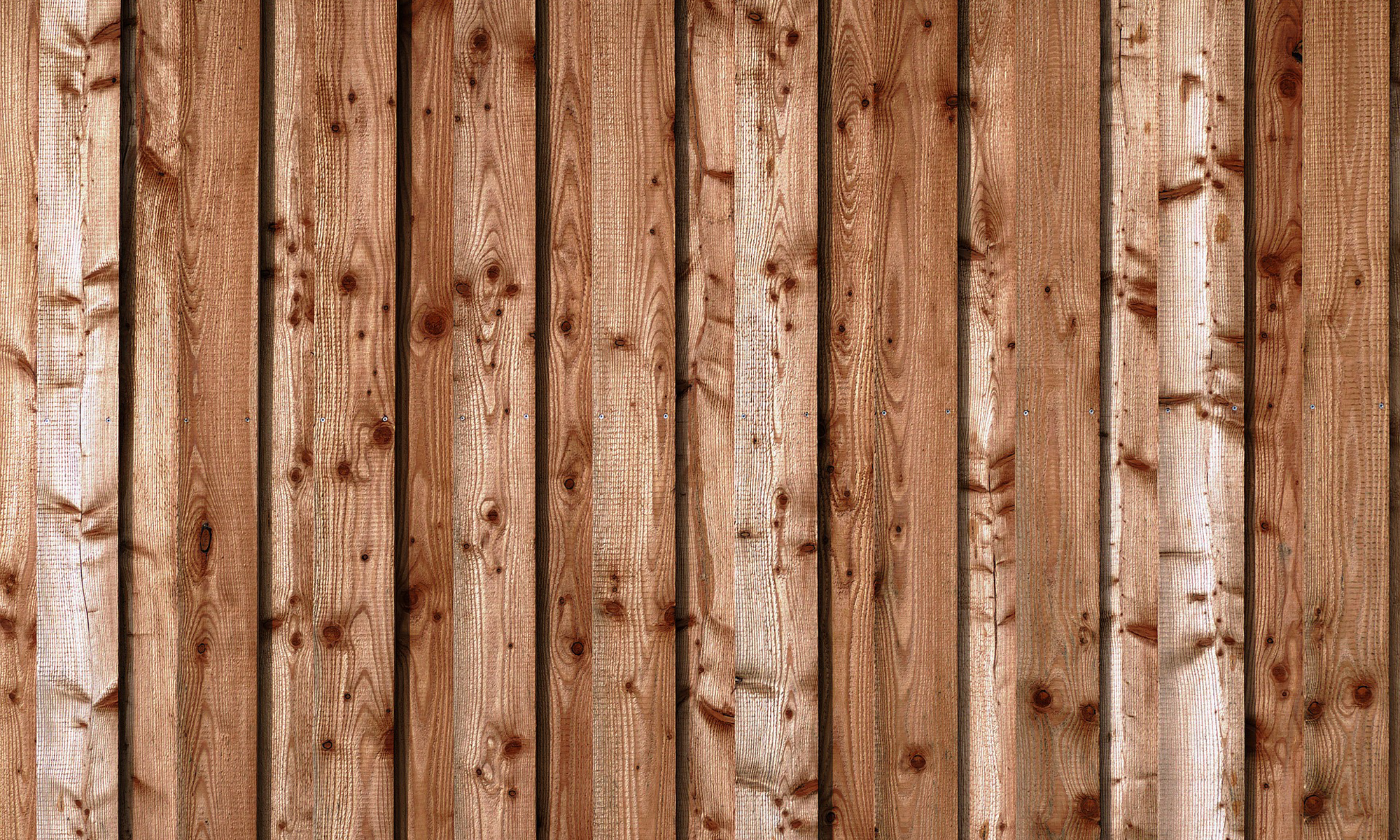
Garden fencing is one of those things you don’t think about until you have to, and then, suddenly, you really have to think about it. A fence blown down by a February storm, panels that have finally given up after fifteen years of Cheshire weather, a new garden that needs boundaries before anything else can begin. When that moment comes, the question isn’t just “who can I call?” It’s “what should I actually get?”
The range of fencing options available in 2024 is wider than most homeowners realise, and the quality gap between a fencing installation done properly and one that’s done cheaply is wider still. The wrong product, the wrong posts, the wrong fixing method: these are choices that look fine in summer and fail quietly over three or four winters, leaving you back where you started.
This guide is for Altrincham homeowners who want to get this right first time. By the end of it, you’ll understand every main fencing option, know why posts matter more than panels, have a clear sense of what realistic costs look like in WA14 and WA15, and know exactly what to look for, and what to avoid, when choosing a contractor.
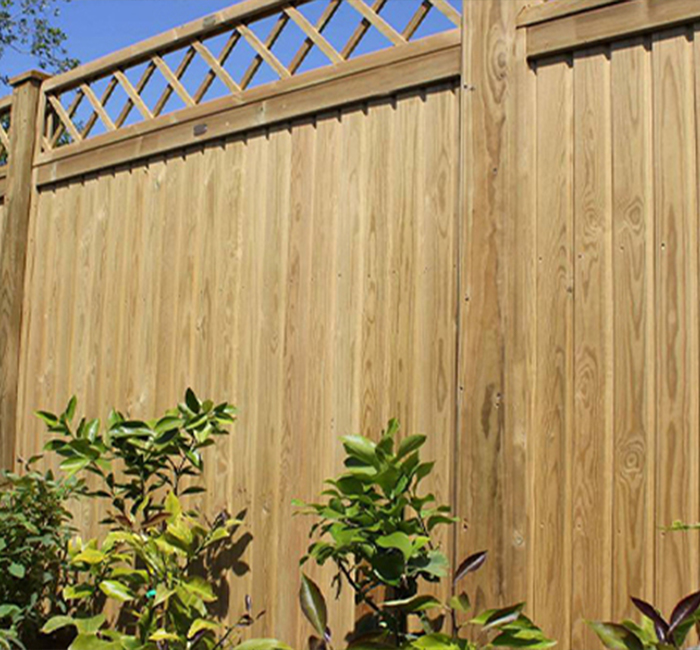
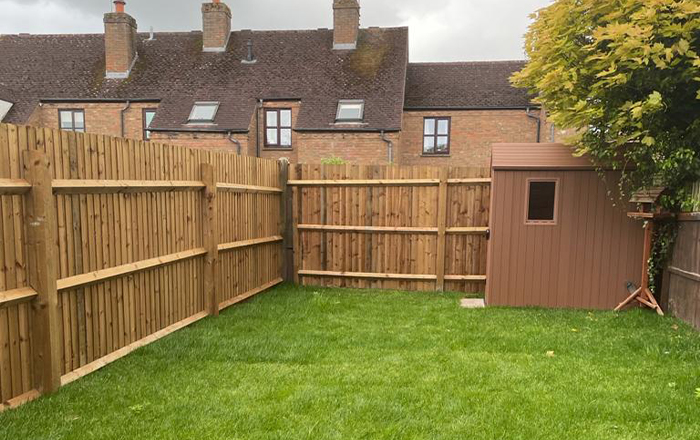
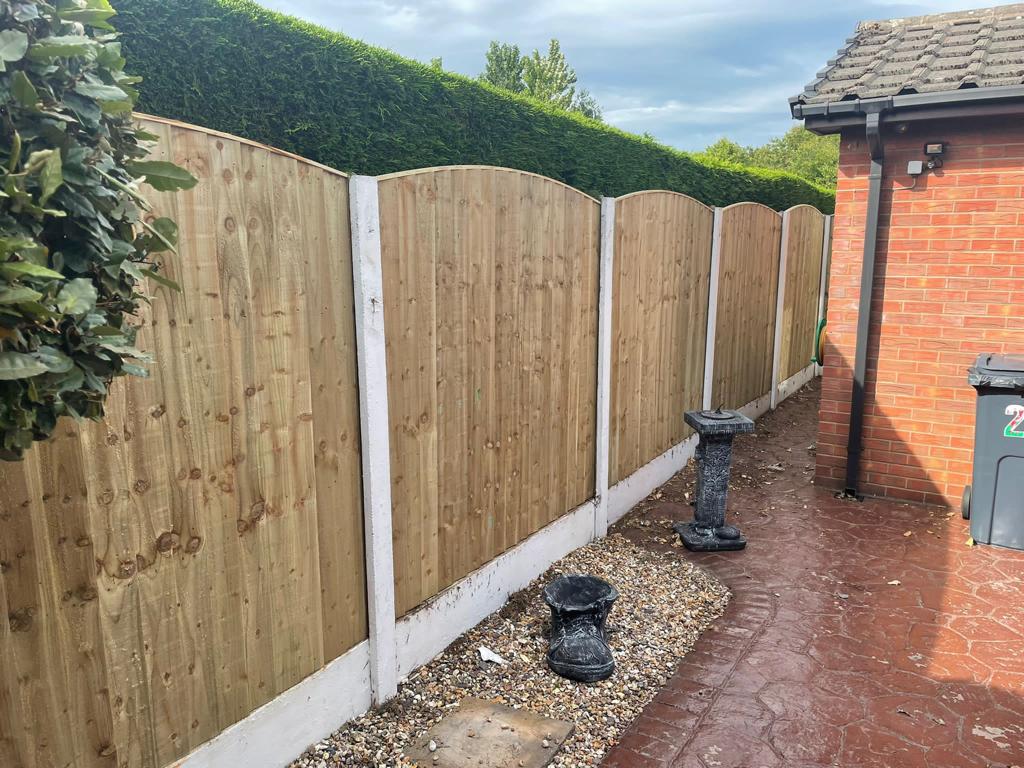
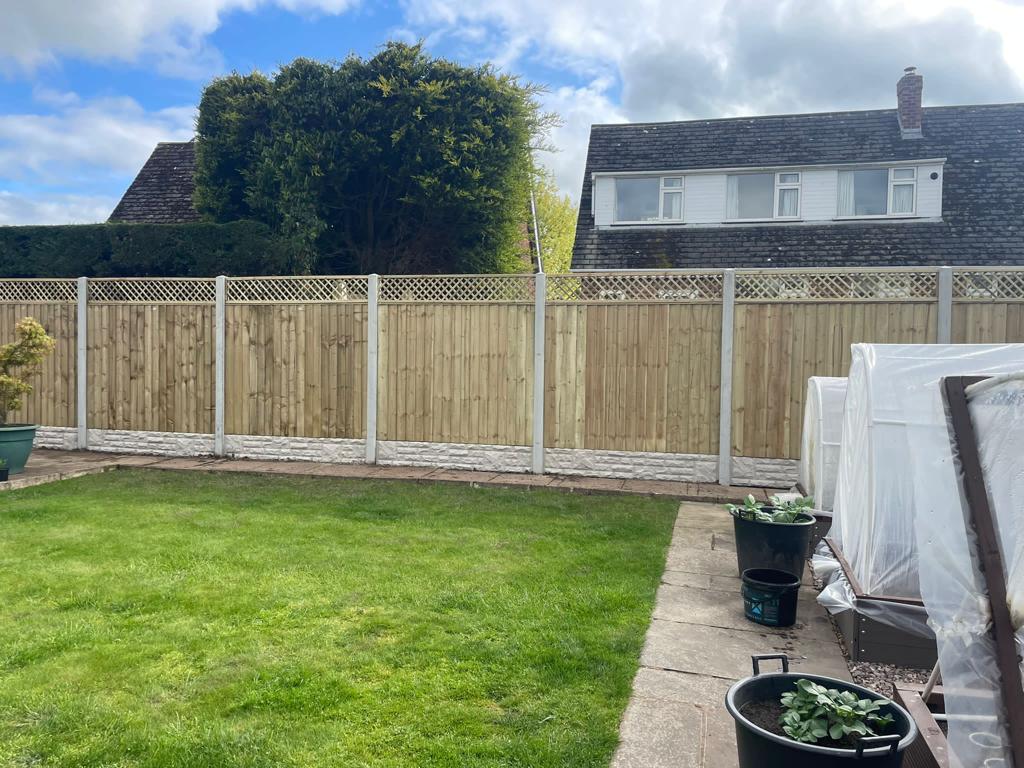
A garden boundary does several jobs simultaneously, and the weight each job carries varies by property and homeowner. Understanding what you’re primarily asking your fence to do is the starting point for choosing the right product.
Privacy is the most cited reason for fencing in Altrincham’s residential gardens, particularly in the denser streets of Timperley and Sale where gardens are narrower and neighbouring properties are close. A full-height close-board fence provides a genuine visual barrier; a lap panel fence of the same nominal height is less effective because the horizontal overlap allows partial sight lines through. The distinction matters when privacy is the primary goal.
Security — keeping children and pets in, and unwanted visitors out, places different demands on a fence than privacy does. Security fencing needs to be difficult to climb, resistant to being lifted or pushed through, and anchored in posts that don’t flex under lateral pressure. A decorative picket fence solves neither problem; a properly installed close-board or featherboard fence addresses both.
Aesthetics — how the boundary looks from both inside and outside the garden, matters more than many homeowners initially admit, and has a genuine effect on the character of the outdoor space. A garden with cheap lap panels and cracking timber feels like a lesser space. The same garden with quality composite panels and matching posts feels considered and finished.
Longevity — how long you expect the fence to last before replacement, is the factor that most directly determines which product and specification represents real value rather than apparent value.
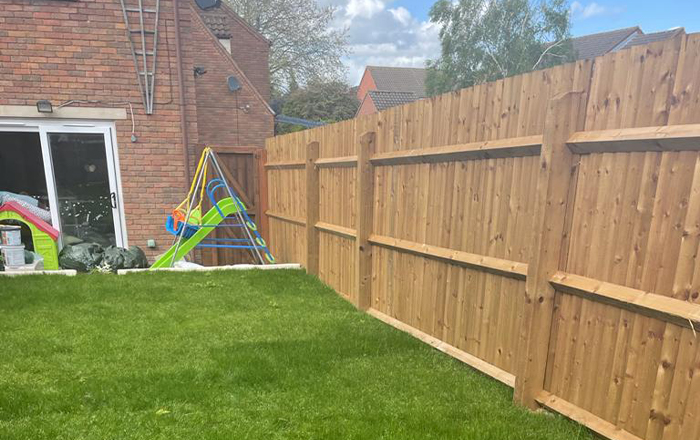
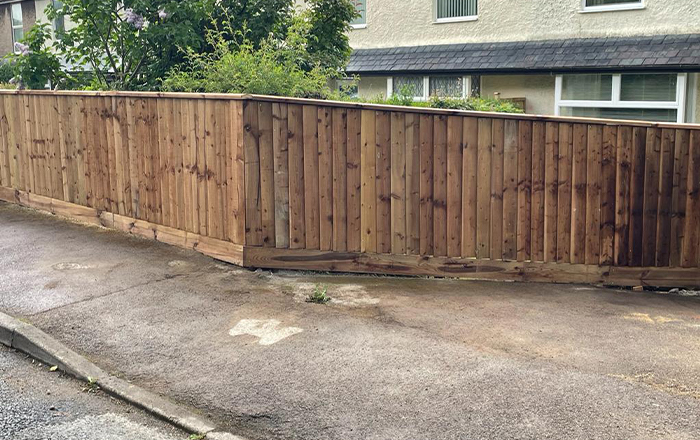
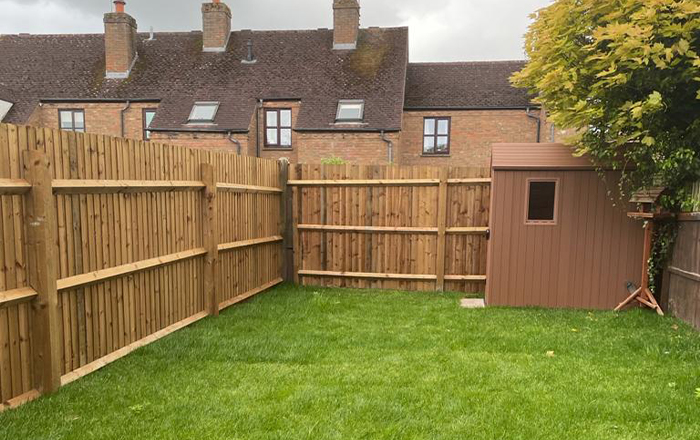
The gold standard for residential garden fencing across Greater Manchester, and the right choice for the majority of Altrincham gardens that need full privacy and security at a reasonable price.
Close-board panels are constructed from individual vertical timber boards (the “feather-edge boards”) nailed to horizontal arris rails within a framed panel. The boards overlap slightly at each edge, creating a solid barrier with no horizontal gaps. The result is a fence that:
Close-board is the right choice for boundary fencing between neighbours, rear garden privacy, and anywhere the fence needs to look intentional and perform well over time. Treated softwood close-board is the most common specification; hardwood or pressure-treated options are available for longer service life.
Essentially the same product as close-board but constructed on-site board-by-board rather than as pre-built panels. Each tapered feather-edge board is fixed individually to arris rails that span between posts, producing a continuous run of fencing without the interruption of panel frames.
The advantages of featherboard over close-board panels are:
For long runs of boundary fencing on sloped Altrincham gardens, featherboard is often the more practical and better-looking solution than panel fencing.
The most widely sold and most widely replaced fencing product in the UK. Lap panels consist of horizontal strips of thin timber overlapping each other in a panel frame, they’re cheap to produce, cheap to buy, and proportionally cheap in performance.
To be fair to lap panels: they’re perfectly adequate as a temporary boundary or for low-height applications where privacy and security aren’t the primary concern. But in the north-west’s climate, persistent rain, regular high winds, a standard lap panel fence has a realistic lifespan of seven to ten years before panels begin warping, splitting, and failing. If you’re replacing lap panels, replacing them with lap panels is choosing to have this conversation again in a decade.
For rear gardens where longevity and performance matter, close-board or composite is almost always the better long-term decision.
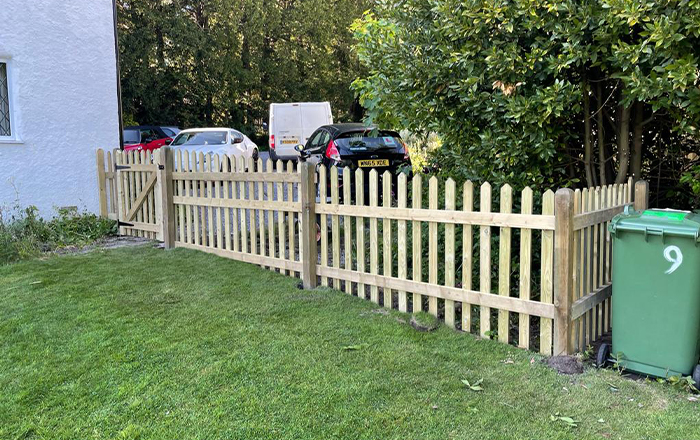
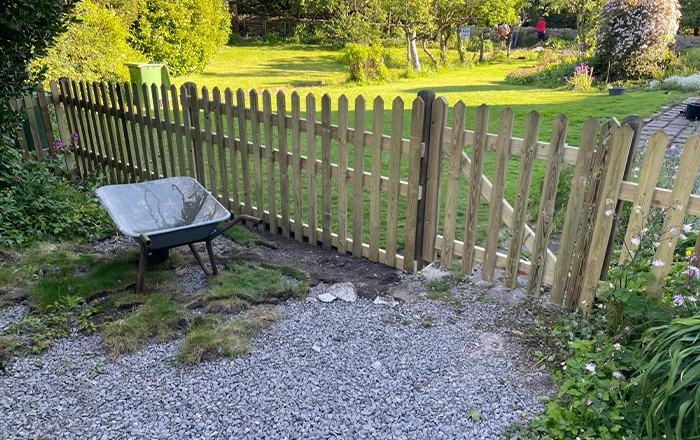
Low-height, open-topped, and primarily decorative. Picket fencing, vertical pointed or rounded pales with gaps between them, is the classic front garden boundary for cottage and period properties. It defines the boundary without creating a barrier, allows planting to flow over and through it, and has a charm that higher security fencing explicitly doesn’t pursue.
Picket fencing is the right choice for:
Painted white softwood is the classic; hardwood, composite, and metal picket options all exist for longer service life or lower maintenance requirements.
Trellis is an open lattice panel used either as a freestanding top section to add height to an existing fence, or as a standalone decorative boundary element for planting support. It provides no privacy or security, but serves a clear purpose where the goal is to support climbing plants while creating a sense of enclosure.
Decorative panels, laser-cut metal, contemporary geometric timber designs, willow hurdle panels, are increasingly popular in Altrincham’s more design-conscious gardens as a departure from utilitarian close-board in key visible sections.
The premium low-maintenance choice, and growing in popularity quickly across the Altrincham and Cheshire market. Composite fencing uses boards manufactured from a blend of wood fibre and recycled plastic, giving the appearance of timber without any of its maintenance requirements.
The practical case:
For Altrincham homeowners who have already invested in a quality driveway and garden and want a boundary that matches that standard without the annual maintenance commitment, composite is a natural choice.
Welded steel or aluminium railing fencing, vertical pale sections in metal rather than timber, provides the highest level of security and the longest service life of any residential fencing product. It’s the choice where security is the absolute priority, particularly for front boundaries on properties with valuable vehicle access points.
Metal railings are also the appropriate aesthetic for some of Altrincham’s more formal period properties, the iron railings that fronted Victorian streets are a missing architectural detail on many local houses, and reinstating them (or a quality modern equivalent) restores a character that close-board fencing can’t replicate.
This is the conversation most homeowners never have with a fencing contractor, and it’s the single most important structural decision in any fencing installation.
The post is the foundation of the fence. Everything else, the panel, the rails, the boards, is only as good as the post it’s attached to. A fence installed on inadequate or deteriorating posts will fail regardless of panel quality.
Timber posts:
Concrete posts:
The honest recommendation for most Altrincham residential gardens: concrete posts with quality panels or featherboard. The upfront premium over timber posts is modest; the longevity payback is substantial. A fence line properly installed on concrete posts is a 30-year decision, not a 10-year one.
For composite fencing, purpose-made aluminium or composite posts are the correct specification, timber and concrete posts are less compatible with composite boards.
A fence without a properly designed gate is a boundary with a weak point, both structurally and aesthetically. Gates should be specified and installed as part of the same project as the fencing, not added as an afterthought.
A pedestrian gate in matching material to the fence, framed close-board, featherboard, or composite, should be hung on a post that is specifically sized and specified for the gate load. Gate posts are typically larger in section than fence posts (100×100mm minimum, 125×125mm for heavier gates) and must be set deeper in concrete to resist the leverage of a swinging gate.
Hardware matters as much as construction: quality galvanised or stainless steel hinges, a self-closing mechanism if children or pets are in the garden, and a latch that operates smoothly from both sides. Cheap hardware fails within a season on a frequently used gate.
Vehicular gates, single or double, spanning a driveway entrance, require substantial gate posts, properly set in concrete at significant depth, to carry the gate weight without leaning or sagging. The post spacing must be exact to the gate specification; it cannot be adjusted after installation.
Options include: framed timber close-board for a traditional look; horizontal composite boarding for a contemporary aesthetic; metal frame with timber or composite infill; or fully metal gates in painted steel or aluminium for maximum durability and security.
Where automated gate systems are planned, electrical conduit and access point provision should be incorporated at installation stage rather than retrofitted later.
The key planning rules for residential fences:
For most Altrincham gardens, the standard residential fence height of 1.8m (6ft) for rear and side boundaries is straightforwardly within permitted development. Front garden fencing is where the 1-metre rule matters, and where the character of Altrincham’s residential streets, particularly in the conservation-influenced areas around Bowdon and Hale, makes height and style choices that relate to the neighbourhood character particularly important.
Practical height guidance:
| Situation | Recommended Height | Notes |
|---|---|---|
| Front garden (adjacent to road) | 600–900mm | Planning limit 1m; lower often looks better |
| Side boundary (neighbour) | 1.8m | Standard privacy height |
| Rear boundary | 1.8m | Standard privacy height |
| Garden adjacent to open land | 1.8m–2.0m | Check planning position |
| Pool or play area enclosure | 1.2m minimum | Safety consideration |
Fencing in Greater Manchester faces some specific challenges that generic installation advice doesn’t address.
Wind exposure. Greater Manchester and the exposed Cheshire plain to the south of Altrincham experience some of the most sustained wind events in England. The combination of prevailing westerlies off the Irish Sea and the funnel effect of valleys around the Bollin means that standard lap panel fencing, the type with the worst wind resistance of any common product, fails in this area more reliably than almost anywhere else in the country. Close-board, featherboard, or composite with properly concreted posts is the correct specification for any exposed Altrincham garden. If your last fence blew down, the product and post specification, not bad luck, is almost certainly why.
Clay soils and post stability. The clay-heavy ground across Timperley, Sale, and parts of Hale expands when wet and shrinks when dry, a seasonal movement that works timber posts loose over time if they’re not set in a concrete collar that extends below the frost line. Posts concreted to a minimum depth of 600mm in a collar that extends at least 150mm on each side of the post hold far better in clay than posts driven or rammed.
Mature gardens and root zones. Many Altrincham properties have mature trees whose root systems extend under the fence line. Post installation in these zones needs care, mechanical augering is often preferable to driven posts to avoid major root damage that would destabilise the post over time.
These two boundary solutions are often considered as alternatives, and the honest comparison is worth having:
| Factor | Timber/Composite Fencing | Brick/Block Garden Wall |
|---|---|---|
| Upfront cost | Lower | Higher |
| Lifespan | 15–30 years (composite) / 10–20 (timber) | 50–100 years |
| Maintenance | Annual treatment (timber) / None (composite) | Minimal |
| Security | Good (close-board) | Excellent |
| Aesthetics on period property | Functional | Premium — matches house |
| Planning (adjacent to road) | 1m max without permission | 1m max without permission |
| Installation speed | Fast (1–3 days typical) | Slower (3–7+ days) |
| Value on resale | Functional | Adds premium kerb appeal |
For most rear garden boundaries, quality fencing represents the right balance of cost and performance. For front boundaries on period properties in Altrincham’s older residential streets, a garden wall in matching brick often produces a result that fencing simply cannot match, and with a lifespan five times longer, the cost difference narrows significantly over time.
The right answer depends on your property, your budget, and your priorities. A contractor who gives you an honest comparison rather than just selling you what they happen to install is the right contractor to work with.
Fencing is almost always more cost-effective, and produces better results, when combined with other garden work rather than treated as a standalone job.
Natural combinations that work well together:
Combining projects means a single period of disruption, coordinated groundwork, and, typically, a better overall price than two separate bookings.
The fencing trade has a low barrier to entry, which means quality varies more than in most garden trades. Here’s what genuinely separates a professional from someone with a van, a post rammer, and an optimistic attitude:
✔ They visit before quoting — Ground conditions, slope, access, existing structures, and root zones all affect the specification and the price. A quote without a site visit is not a quote for your fence.
✔ They specify post material and concrete depth explicitly — If the quote doesn’t state whether posts are concrete or timber, and what depth they’ll be set, you cannot hold them to any particular standard. This is the most important structural detail and the most commonly omitted one.
✔ They discuss wind exposure honestly — In Altrincham’s climate, a contractor who recommends standard lap panels on timber posts for an exposed rear garden is not giving you advice in your interest.
✔ They carry full public liability insurance — Any fencing adjacent to the public highway, neighbouring properties, or overhead cables requires cover. Ask for the certificate before work starts.
✔ They handle the disposal of old fencing — A professional job leaves the garden clean. Skips left on site for weeks, or old panels left for you to dispose of, are signs of a disorganised operation.
✔ They offer a written guarantee — Five years minimum on workmanship; ten years from the best operators.
✔ They have local examples — Ask to see a fence they’ve installed in Altrincham, Hale, or Timperley that is at least two or three years old. Wind resistance and post stability show themselves over time.
✅ Measure the total run length (all sections, including gates)
✅ Note the fence heights required, check whether any section is adjacent to a highway
✅ Check whether your property is in or near an Altrincham conservation area
✅ Identify any slopes, mature trees, or access restrictions along the fence line
✅ Decide on product type, close-board, featherboard, composite, picket
✅ Confirm whether you need gates and at what widths
✅ Consider whether combining with patio, turfing, or driveway work makes sense
✅ Get three written quotes with post specification and concrete depth stated
✅ Ask each contractor about their approach to wind-exposed runs
Do I need planning permission for a garden fence in Altrincham? Not in most cases. Fences up to 2 metres are permitted development on most residential properties, except where adjacent to a highway (road or footpath), where the limit drops to 1 metre. Properties in or near Altrincham’s conservation areas, around Bowdon, Hale, and parts of the town centre, may have additional restrictions, particularly for front garden boundaries visible from the street. Always check with Trafford Council if you’re in any doubt about your specific property. A reputable contractor will flag any planning considerations during their site visit.
How long does a fence installation take? A standard residential fence run of 20–30 metres typically takes one to two days for an experienced team, including post setting in concrete and panel or board installation. Concrete needs 24–48 hours to cure before the fence takes any significant load, posts can be installed one day and panels the next. Longer or more complex runs, sloped ground, or combined gate projects take proportionally longer.
Concrete or timber posts — which should I choose? For any installation intended to last more than ten years in Altrincham’s conditions, concrete posts are the correct recommendation. Timber posts, even well-treated ones, are vulnerable to ground-level rot, particularly in the clay-heavy soils of much of the Altrincham area. Concrete posts have a virtually indefinite lifespan in the ground and allow panel replacement without disturbing the post line. The upfront premium over timber posts is modest; the long-term payback is substantial.
What is the best fencing for a windy Altrincham garden? Close-board panels on concrete posts, or featherboard on concrete posts, are the correct specification for exposed gardens in Greater Manchester. Both products are significantly more wind-resistant than lap panel alternatives due to their solid board construction and panel rigidity. Composite fencing on purpose-made posts is the premium option for maximum lifespan and wind resistance. The critical element, for any product, is post depth and concrete collar specification. Posts that aren’t adequately set in concrete will fail in high winds regardless of panel quality.
What is composite fencing and is it worth the extra cost? Composite fencing uses boards made from a blend of wood fibre and recycled plastic, giving a timber-like appearance with none of timber’s maintenance requirements, no rotting, warping, splitting, or annual treatment. Quality composite products carry 25-year manufacturer guarantees on colour and structural integrity. The upfront cost is 2–3× higher than timber close-board. Over a 25-year period, factoring in zero maintenance cost and no replacement, composite typically represents better value than timber for homeowners who plan to remain in their property long-term.
Can I paint or stain my fence? Timber fencing, close-board, featherboard, and lap panels, can all be stained or painted, and should be treated regularly (every two to three years) with a quality timber preservative or fence stain to maintain the wood and extend the lifespan. Fresh-sawn timber should be allowed to weather for three to six months before the first treatment application for best absorption. Composite fencing cannot be painted and should not be, the colour is integral to the manufacturing process and requires no treatment.
Who owns the fence between my property and my neighbour? Ownership of boundary fences is determined by the title deeds and Land Registry information for your property, not by any general rule about which side the posts are on. Your deeds will indicate which boundaries are your responsibility with a “T” mark on the boundary line. In practice, many neighbours simply agree on a shared approach to boundary maintenance regardless of technical ownership. If ownership is disputed, your conveyancing solicitor or the Land Registry records are the correct starting point — not assumptions based on post position.
Can fencing be installed on a slope? Yes, this is extremely common in Altrincham’s residential gardens, many of which slope significantly. There are two approaches: stepped panels (each panel is level, with the ground stepping beneath it, producing a gap under each panel at the low end) and raked fencing (panels or boards follow the slope of the ground continuously). Featherboard is the more adaptable product for sloped ground, each board can be cut to follow the gradient, producing a smooth, continuous line without the gaps that stepped panels produce. A good contractor will discuss the appropriate approach for your specific slope during the site visit.
How do I maintain timber fencing to make it last? Annual or biennial maintenance keeps timber fencing performing well:
What width should a driveway gate be? For a single car, a minimum clear opening width of 2.7–3 metres is recommended, wider if you drive an SUV or larger vehicle, or if the approach angle requires extra clearance. Double gates typically split this opening with a central meeting point. The width of the gate opening must be precisely established before gate posts are set, it cannot be adjusted afterwards. Your contractor should measure your vehicle and the driveway approach at the quoting stage, not assume a standard width.
The right fence, properly specified for your conditions, installed with posts that will hold in Altrincham’s clay soils and Atlantic weather, and built to a standard that doesn’t require revisiting in five years, is a straightforward upgrade to your property that pays back in security, privacy, and garden character for decades.
Deluxe Driveways installs garden fencing of every type, close-board, featherboard, composite, picket, and metal, across Altrincham, Hale, Bowdon, Timperley, Sale, and the wider Greater Manchester and Cheshire area. We specify concrete posts as our default recommendation for most residential installations, concrete every post to the correct depth, and offer a 10-year workmanship guarantee backed by full public liability insurance.
We’re also the team to call when fencing is part of a bigger picture, garden walls and brick piers, block paving driveways, patios, turfing and artificial grass, and decking, so your garden gets finished as a whole, not piecemeal.
Call 0800 191 0959 for your free no-obligation quote. We’ll visit, assess the run, advise honestly on product and post specification, and give you a written price with a 14-day cooling-off period.

Deluxe Driveways are a property maintenance company with many years of experience in a range of areas. Deluxe Driveways take pride in delivering the quality results which you deserve.
Deluxe Driveways are more than happy to offer FREE, no-obligation quotes. We are here to work closely with you on any projects.
From block paving and resin to patios and deckings, Deluxe Driveways expertise spans across many fields and are on hand to cover you for all of your needs.
Deluxe Driveways's experience in the paving & driveway industry is second to none, we have been around for a while and seen almost everything on the job so you can be confident in hiring us!
Deluxe Driveways cover a wide geographical area including Greater Manchester & Cheshire. Please get in touch to find out if Deluxe Driveways cover your area.
We endeavour to always leave our customers satisfied with our high quality work and this includes causing as little disruption as is possible and leaving your property clean and tidy.
Greater Manchester & Cheshire
30 The Downs Altrincham WA14 2PX